Stop Messing
Around with AI
One hour. Find out what's left of your expertise when AI knows everything.
Audit what your expertise is actually made of. Find where genuine judgement creates irreplaceable value. Leave knowing how to develop it deliberately.
A must for every expert, leader and professional.
A new model for what expertise means in the AI age
A reframing of professional expertise — what it is now, what it isn't any more, and why the shift is an opportunity.
Practical approaches to developing better judgement
Concrete methods for sharpening judgement — the decisions, habits and practices that develop it over time.
Clarity on where human judgement creates irreplaceable value
A map of where human judgement matters most — and where it's being underused or bypassed.
 Getting Started
Stop Messing
Around with AI
Judgement Advantage
What expertise means when AI knows everything
 Show me the value
AI Powered
Show me the value
AI Powered
AI can synthesise, recall and apply information at a scale no individual can match - and that's permanently changing what expertise means. But what doesn't change is the quality of judgement: when to act and when to wait, the read of a situation no data set fully captures, the ethical line experience has taught you to hold.
Tom draws on examples from law, medicine, finance and consulting to show where human judgement creates irreplaceable value - and where it's currently being underused. Audiences leave both humbled by what AI can do and confident about what they bring that it can't.
Suitable for
Professional services firms and leadership teams. Particularly resonant for lawyers, consultants, doctors and financial advisers.
Format & logistics
Content mix
This talk leads directly to the Give Experts New Advantage workshop — developing and demonstrating expertise in an AI world.
Go to Workshop ↓ Take it further
Give Experts
New Advantage workshop
Show me the value
AI Powered
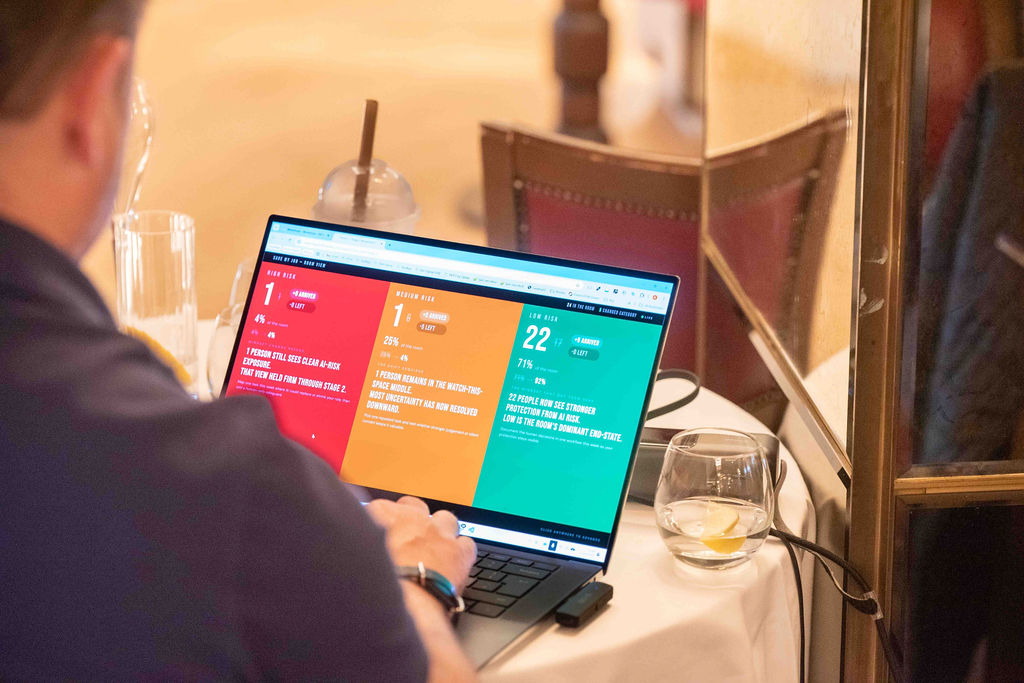
Participants examine their own expertise honestly - what it consists of, and how much is genuine judgement advantage versus information advantage that AI is eroding. The outcome is a clear view of where their compounding expertise actually lives.
The workshop also addresses professional identity - how to talk about what you bring that AI can't replicate, and how to develop the next generation of expertise when traditional pathways have changed.
Logistics
Content mix
What happens in the room.
Five phases of honest work. Hard questions about what expertise actually consists of — but the output is clarity and confidence most professionals haven't had before.
Expertise audit
25–35 minEach participant maps their expertise honestly — what it consists of and how much is genuine judgement versus accumulated information that AI is eroding.
Judgement mapping
50–60 minParticipants identify the moments where genuine judgement is required — where experience, values and contextual awareness create outcomes no AI can reach.
The expert identity
40–50 minHow do you communicate your judgement advantage when AI matches your knowledge base? This phase builds the language for expressing expertise that clients and organisations can recognise and value.
Developing judgement
35–45 minJudgement develops through deliberate practice. This phase builds practical approaches to developing it — individually and collectively — including where it's currently being bypassed.
Personal plan
20–25 minConcrete commitments for developing and demonstrating the judgement advantage — not aspirations. A shared language for expertise that carries far beyond the room.
The workshop leads to the Decision Intelligence Lab — a disciplined, systematic approach to better decision-making in an AI world.
See the programme ↓
Three intensive sessions over four to six weeks. The Lab builds a disciplined decision framework and embeds it in how your leadership team actually operates.
Content mix
Decision audit
We map the decisions your leadership team makes and examine how they're currently made — where AI is already influencing them, where human judgement is being bypassed, and what decision quality you're actually getting.
Framework design
A decision framework specific to your organisation — principles, criteria and processes that systematically improve quality — tested against real decisions the team is facing.
Integration & practice
Embedding the framework in meeting structures, information flows and review loops. The goal is a team that makes consistently better decisions — not a team with better theory.
Review & calibrate
An optional review 8–12 weeks after the programme — what's working, what needs adjustment. A retrospective that sustains the gains and sets up the next phase.
